
Tuesday
Cooking (measuring volume)


Toddlers (integers)
The integer 1 has taken on a whole new meaning for me in the past year. My 21-month old son is ecstatic to show people how old he is… using both hands! We’re trying to teach him that 1 and 1 is actually 2. Watching my son begin to learn the mathematics in the world around him is amazing, and I can see firsthand how number naming is only the beginning. He may be able to tell us he's one, but he has a ways to go in actually understanding what that means and making meaningful calculations with the numbers he learns. Baby steps!

Football (measuring distance)

Script Ohio is performed by the Ohio State Marching Band on the football field, and requires precise measurements and impeccable timing. To view a performance of Script Ohio, click on the picture:

Mortgage (compound interest)
While death and taxes may be two certainties in life, so is the monthly arrival of the mortgage. When we purchased our house three years ago, my husband and I spent countless hours on mortgage calculators to determine our compound interest over a 30-year term. Simple interest would have been, well, simpler! For a compound interest calculator, click here.

Art (projective geometry)

Grocery shopping (mathematical microcosm)


Tracking time (formulas)
In addition to school, I also work part-time and keep track of my hours on a timesheet. I submit this to my company totaled by date, and sometimes by client. I track this information in Excel and use SumIf formulas for easy addition in different categories. It’s a major time saver and would not be possible without applying mathematical skills.


Media Planning (analyzing and categorizing data)
Another part of my part-time job involves crunching a lot of data and creating graphs to present this data in a user friendly way. In order to take raw data and determine how to show this visually requires formulas to extract the relevant data, determining the appropriate data for the x and y axes and scaling the data to the proper proportions. In the end, the client appreciates seeing the information clearly presented, instead of a list of numbers.


Broadcasting (frequency and wavelength)

Floor plan (scale)

Eating (calories)

Weather (temperature)
The weather is always a major topic of conversation in my Midwestern family (so much so that my father was a member of the Weather Club at his junior high school). I regularly discuss with him temperature and precipitation, and sometimes even barometric pressure. Wind chill, the combination of temperature and wind speed as it feels to humans, is definitely his favorite topic. After some research, I discovered that the mathematical formula for determining the windchill factor in degrees Fahrenheit is:
Twc = (0.3V0.5 + 0.474 - 0.02V)(T - 91.4) + 91.4
(Twc is the wind chill, V is the wind speed in statute miles per hour, and T is the temperature in degrees Fahrenheit)
Luckily, we have weather reporters to do this for us!

Twc = (0.3V0.5 + 0.474 - 0.02V)(T - 91.4) + 91.4
(Twc is the wind chill, V is the wind speed in statute miles per hour, and T is the temperature in degrees Fahrenheit)
Luckily, we have weather reporters to do this for us!
Angles (geometry)

Fountains (patterns)
In 2003, Essex Junction created a War Memorial in Five Corners to honor those who have served in the arm forces. Living in the Junction, I pass this memorial at least a few times a week, and it always catches my attention. It is visually appealing because of the pattern the designers created – circular horizontally, and flags vertically. The symmetrical design draws the eye and creates a sense of organization and order in the memorial.
Light Bulbs (energy measurement)
 In an effort to do our part for the environment and energy conversation, our family recently switched our household light bulbs to compact fluorescent light bulbs. After researching savings in both watts (a mathematical measurement!) and money (more math!), it was a no-brainer. A 75-watt incandescent bulb is equivalent to 20 watts with a compact fluorescent bulb. According to Fast Company, “They use so little power compared with old reliable bulbs, a $3 swirl pays for itself in lower electric bills in about five months.”
Quad marker screening (measurement, proportions)
My husband and I are expecting our second child in September, and just like all parents, our main concern is the health of the baby. We chose to have a quad marker screening, which requires amazingly precise mathematical measurements and calculations. The screening test measures four substances in a blood sample. The levels are compared to normal amounts for the current gestation period. If the due date is calculated incorrectly, or any of the substances are measured incorrectly, the results will be inaccurate. For more information on the Quad Marker test, click here.
Stocks (fractions/decimals)

Painting (area)

Magic (it’s really math)

Music (fractions)
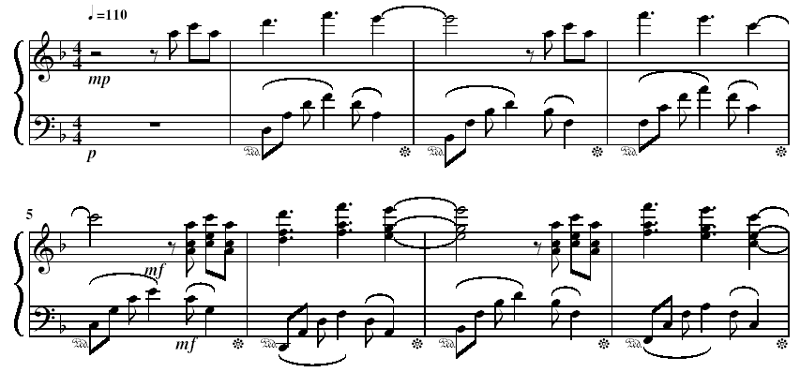
Listen to a Piano Solo
Music is a great way to teach children math. Click here for a sample lesson plan.
Lottery (probability)

Polls (statistics)
As we head towards another election year, we are already starting to see advertisements and hear debates from the candidates. An important tool in campaigning is also the polls. Most polls are qualified with a stated margin of error. What does this mean? Can we trust the polls? According to Scientific American, “The margin of error depends inversely on the square root of the sample size.” The bigger the sample size, the smaller the margin of error. However, even this calculation can’t correct all errors. Polls can be biased. For example, a phone poll doesn’t reach the segment of the population without phones. Perhaps even more importantly, people change their minds.

Growth Charts (percentiles)

Click here for a growth chart percentile calculator.
City Planning (geometry)
 City planning takes countless mathematical concepts, from layouts to infrastructure. Nowhere is this more obvious than my hometown of Bexley, Ohio. Much of the Midwest was created in a grid system, almost perfectly geometrical layouts dominated by neighborhoods in configurations of block after block. This system is what is known as the Jeffersonian grid. According to the design website Core 77, "The Land Ordinance of 1785, drafted by Thomas Jefferson, extended government authority over the Mississippi River and the Great Lakes regions. As a response to what he believed to be a confusing survey system already in use, Jefferson suggested a new grid system based on the rectangle. The grid divided land into plots one mile square, each consisting of 640 acres. The grid also placed a visible design upon a relatively untouched landscape. The ordinance was the first of its kind in America but would continue to affect urban, suburban and farmland planning to present day."
Nature (Fibonacci numbers)

Subscribe to:
Posts (Atom)